
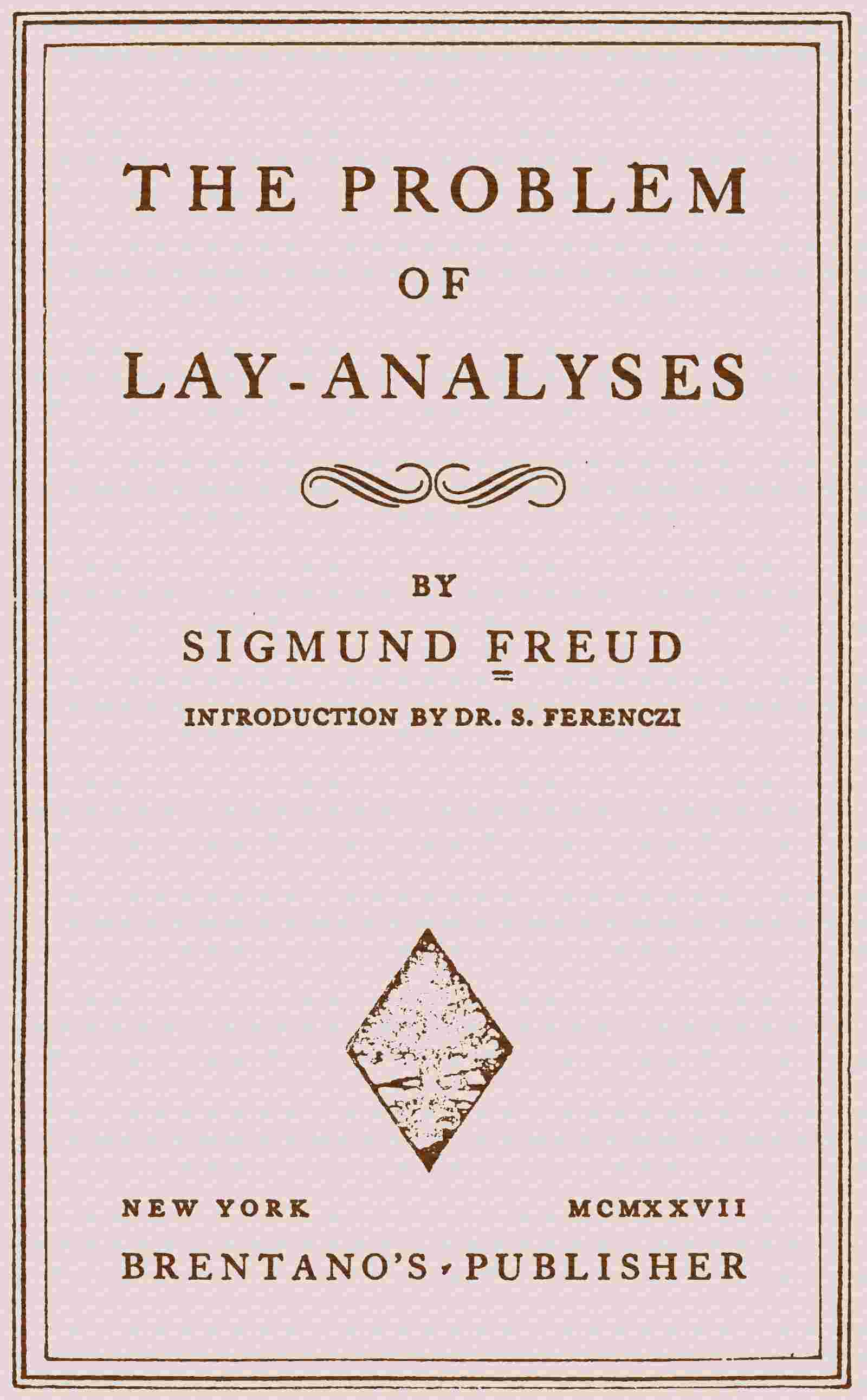
About This Book
The work examines whether individuals without medical degrees may practice psychoanalysis, arguing that true competence rests on self-knowledge of unconscious processes and thorough analytic training rather than formal medical credentials, while insisting on medical evaluation to rule out organic illness. It condemns both medically and non-medically trained quackery, recommends wider dissemination of psychoanalytic knowledge for teachers, social workers, and related professions, and proposes practical and ethical safeguards for lay practice. An accompanying autobiographical study reflects on the author’s own development and the clinical and conceptual foundations of the discipline.
About the Author

More Books by This Author
6 picks
 A General Introduction to Psychoanalysis
by Sigmund Freud
A General Introduction to Psychoanalysis
by Sigmund Freud
 Animismus, Magie und Allmacht der Gedanken / Über einige Übereinstimmungen im Seelenleben der Wilden und der Neurotiker III
by Sigmund Freud
Animismus, Magie und Allmacht der Gedanken / Über einige Übereinstimmungen im Seelenleben der Wilden und der Neurotiker III
by Sigmund Freud
 Beyond the pleasure principle
by Sigmund Freud
Beyond the pleasure principle
by Sigmund Freud
 Das Motiv der Kästchenwahl
by Sigmund Freud
Das Motiv der Kästchenwahl
by Sigmund Freud
 Das Tabu und die Ambivalenz der Gefühlsregungen / Über einige Übereinstimmungen im Seelenleben der Wilden und der Neurotiker II
by Sigmund Freud
Das Tabu und die Ambivalenz der Gefühlsregungen / Über einige Übereinstimmungen im Seelenleben der Wilden und der Neurotiker II
by Sigmund Freud
 Das Unheimliche
by Sigmund Freud
Das Unheimliche
by Sigmund Freud
You May Also Like
6 picks
 Measure Your Mind: The Mentimeter and How to Use It
by Marion Rex Trabue
Measure Your Mind: The Mentimeter and How to Use It
by Marion Rex Trabue
 Adolescence
by Stephen Paget
Adolescence
by Stephen Paget
 The art of natural sleep
by Lyman P. Powell
The art of natural sleep
by Lyman P. Powell
 The Developmental Psychology of Psychopathology
by Samuel Vaknin
The Developmental Psychology of Psychopathology
by Samuel Vaknin
 Group Psychology and The Analysis of The Ego
by Sigmund Freud
Group Psychology and The Analysis of The Ego
by Sigmund Freud
 Totem and taboo
by Sigmund Freud
Totem and taboo
by Sigmund Freud