

The Present Condition of Organic Nature / Lecture I. (of VI.), "Lectures to Working Men", at the Museum of Practical Geology, 1863, on Darwin's Work: "Origin of Species"
Explore more books like this:
About This Book
The lecture presents and defends the theory that species arise through variation and natural selection, explaining how heritable differences, competition for resources, and cumulative change produce adaptations and new forms. It reviews anatomical, embryological, and distributional evidence that links organisms by common descent, shows how classification mirrors genealogical relationships, and contrasts biological processes with inorganic phenomena. The speaker emphasizes observation, experiment, and critical reasoning in evaluating hypotheses, addresses common objections to evolutionary explanation, and frames scientific inquiry as a practical method for understanding the organic world rather than as appeal to authority.
About the Author
More Books by This Author
 A Critical Examination of the Position of Mr. Darwin's Work, "On the Origin of Species," in Relation to the Complete Theory of the Causes of the Phenomena of Organic Nature / Lecture VI. (of VI.), "Lectures to Working Men", at the Museum of Practical Geology, 1863, on Darwin's Work: "Origin of Species"
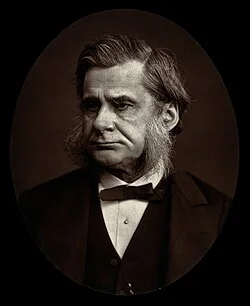
by Thomas Henry Huxley
A Critical Examination of the Position of Mr. Darwin's Work, "On the Origin of Species," in Relation to the Complete Theory of the Causes of the Phenomena of Organic Nature / Lecture VI. (of VI.), "Lectures to Working Men", at the Museum of Practical Geology, 1863, on Darwin's Work: "Origin of Species"
by Thomas Henry Huxley
 American Addresses, with a Lecture on the Study of Biology
by Thomas Henry Huxley
American Addresses, with a Lecture on the Study of Biology
by Thomas Henry Huxley
 Aphorisms and Reflections from the works of T. H. Huxley
by Thomas Henry Huxley
Aphorisms and Reflections from the works of T. H. Huxley
by Thomas Henry Huxley
 Autobiography and Selected Essays
by Thomas Henry Huxley
Autobiography and Selected Essays
by Thomas Henry Huxley
 Collected Essays, Volume V / Science and Christian Tradition: Essays
by Thomas Henry Huxley
Collected Essays, Volume V / Science and Christian Tradition: Essays
by Thomas Henry Huxley
 Coral and Coral Reefs
by Thomas Henry Huxley
Coral and Coral Reefs
by Thomas Henry Huxley
You May Also Like
 Marvels of Pond-life / Or, A Year's Microscopic Recreations Among the Polyps, Infusoria, Rotifers, Water-bears and Polyzoa
by Henry James Slack
Marvels of Pond-life / Or, A Year's Microscopic Recreations Among the Polyps, Infusoria, Rotifers, Water-bears and Polyzoa
by Henry James Slack
 The Ancient Life History of the Earth / A Comprehensive Outline of the Principles and Leading Facts of Palæontological Science
by Henry Alleyne Nicholson
The Ancient Life History of the Earth / A Comprehensive Outline of the Principles and Leading Facts of Palæontological Science
by Henry Alleyne Nicholson
 House Rats and Mice
by David E. Lantz
House Rats and Mice
by David E. Lantz
 Het Leven der Dieren: Hoofdstuk 8: De Vinduikers; Hoofdstuk 9: de Stormvogels
by Alfred Edmund Brehm
Het Leven der Dieren: Hoofdstuk 8: De Vinduikers; Hoofdstuk 9: de Stormvogels
by Alfred Edmund Brehm
 The Mechanism of Life
by Stéphane Leduc
The Mechanism of Life
by Stéphane Leduc
 The Structure and Habits of Spiders
by J. H. Emerton
The Structure and Habits of Spiders
by J. H. Emerton