

Collected Essays, Volume V / Science and Christian Tradition: Essays
Explore more books like this:
About This Book
The collection presents essays probing the friction between scientific inquiry and Christian tradition, surveying scientific and pseudo-scientific realism, defending agnosticism, and challenging literal interpretations of sacred texts. It examines the limits of historical and testimonial evidence for miracles, critiques ecclesiastical defenses of biblical infallibility, analyzes controversial rhetorical methods used in theology and politics, and explores methodological boundaries for what can be known. Across polemic and reflection, it urges rigorous critical scrutiny, intellectual honesty, and inward preparation rather than premature reconstruction of religious doctrine.
About the Author
More Books by This Author
6 picks
 A Critical Examination of the Position of Mr. Darwin's Work, "On the Origin of Species," in Relation to the Complete Theory of the Causes of the Phenomena of Organic Nature / Lecture VI. (of VI.), "Lectures to Working Men", at the Museum of Practical Geology, 1863, on Darwin's Work: "Origin of Species"
by Thomas Henry Huxley
A Critical Examination of the Position of Mr. Darwin's Work, "On the Origin of Species," in Relation to the Complete Theory of the Causes of the Phenomena of Organic Nature / Lecture VI. (of VI.), "Lectures to Working Men", at the Museum of Practical Geology, 1863, on Darwin's Work: "Origin of Species"
by Thomas Henry Huxley
 American Addresses, with a Lecture on the Study of Biology
by Thomas Henry Huxley
American Addresses, with a Lecture on the Study of Biology
by Thomas Henry Huxley
 Aphorisms and Reflections from the works of T. H. Huxley
by Thomas Henry Huxley
Aphorisms and Reflections from the works of T. H. Huxley
by Thomas Henry Huxley
 Autobiography and Selected Essays
by Thomas Henry Huxley
Autobiography and Selected Essays
by Thomas Henry Huxley
 Coral and Coral Reefs
by Thomas Henry Huxley
Coral and Coral Reefs
by Thomas Henry Huxley
 Criticisms on "The Origin of Species" / From 'The Natural History Review', 1864
by Thomas Henry Huxley
Criticisms on "The Origin of Species" / From 'The Natural History Review', 1864
by Thomas Henry Huxley
You May Also Like
6 picks
 Spirit and Music
by H. Ernest Hunt
Spirit and Music
by H. Ernest Hunt
 Discours par Maximilien Robespierre — 17 Avril 1792-27 Juillet 1794
by Maximilien Robespierre
Discours par Maximilien Robespierre — 17 Avril 1792-27 Juillet 1794
by Maximilien Robespierre
 The Way of Salvation in the Lutheran Church
by G. H. Gerberding
The Way of Salvation in the Lutheran Church
by G. H. Gerberding
 The Life of Col. James Gardiner / Who Was Slain at the Battle of Prestonpans, September 21, 1745
by Philip Doddridge
The Life of Col. James Gardiner / Who Was Slain at the Battle of Prestonpans, September 21, 1745
by Philip Doddridge
 Book of Wise Sayings / Selected Largely from Eastern Sources
by W. A. Clouston
Book of Wise Sayings / Selected Largely from Eastern Sources
by W. A. Clouston
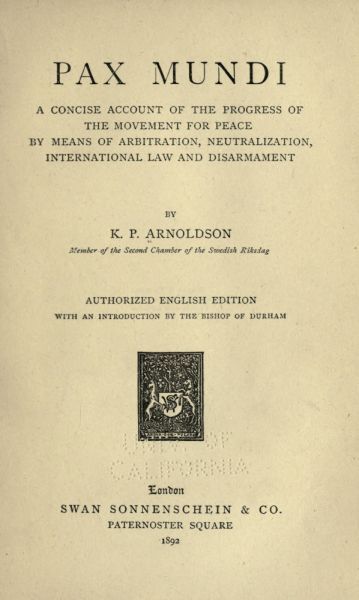 Pax mundi
by K. P. Arnoldson
Pax mundi
by K. P. Arnoldson