
About This Book
The essay surveys the scope and methods of studying animal life, distinguishing natural history, biology, zoology, and their subfields—morphology, physiology, and distribution—and argues for teaching grounded in direct observation and logical analysis. Using a lobster as a worked example, it demonstrates segmentation, homology, and modification of repeated structures to illustrate comparative anatomy and development. It links morphological and physiological facts to environmental distribution, and emphasizes that studying common organisms, precise description, and inferential reasoning lead to broader zoological generalizations. Practical guidance on classification, anatomy, and experimental approach accompanies reflections on how specialization shapes the scientist's focus.
About the Author
More Books by This Author
 A Critical Examination of the Position of Mr. Darwin's Work, "On the Origin of Species," in Relation to the Complete Theory of the Causes of the Phenomena of Organic Nature / Lecture VI. (of VI.), "Lectures to Working Men", at the Museum of Practical Geology, 1863, on Darwin's Work: "Origin of Species"
by Thomas Henry Huxley
A Critical Examination of the Position of Mr. Darwin's Work, "On the Origin of Species," in Relation to the Complete Theory of the Causes of the Phenomena of Organic Nature / Lecture VI. (of VI.), "Lectures to Working Men", at the Museum of Practical Geology, 1863, on Darwin's Work: "Origin of Species"
by Thomas Henry Huxley
 American Addresses, with a Lecture on the Study of Biology
by Thomas Henry Huxley
American Addresses, with a Lecture on the Study of Biology
by Thomas Henry Huxley
 Aphorisms and Reflections from the works of T. H. Huxley
by Thomas Henry Huxley
Aphorisms and Reflections from the works of T. H. Huxley
by Thomas Henry Huxley
 Autobiography and Selected Essays
by Thomas Henry Huxley
Autobiography and Selected Essays
by Thomas Henry Huxley
 Collected Essays, Volume V / Science and Christian Tradition: Essays
by Thomas Henry Huxley
Collected Essays, Volume V / Science and Christian Tradition: Essays
by Thomas Henry Huxley
 Coral and Coral Reefs
by Thomas Henry Huxley
Coral and Coral Reefs
by Thomas Henry Huxley
You May Also Like
 Der Tabak: Studien über seine Kultur und Biologie
by C. J. Koning
Der Tabak: Studien über seine Kultur und Biologie
by C. J. Koning
 Physics and Politics, or, Thoughts on the application of the principles of "natural selection" and "inheritance" to political society
by Walter Bagehot
Physics and Politics, or, Thoughts on the application of the principles of "natural selection" and "inheritance" to political society
by Walter Bagehot
 McGuffey's Third Eclectic Reader
by William Holmes McGuffey
McGuffey's Third Eclectic Reader
by William Holmes McGuffey
 Journals of Travels in Assam, Burma, Bhootan, Afghanistan and the Neighbouring Countries
by William Griffith
Journals of Travels in Assam, Burma, Bhootan, Afghanistan and the Neighbouring Countries
by William Griffith
 Sermons at Rugby
by John Percival
Sermons at Rugby
by John Percival
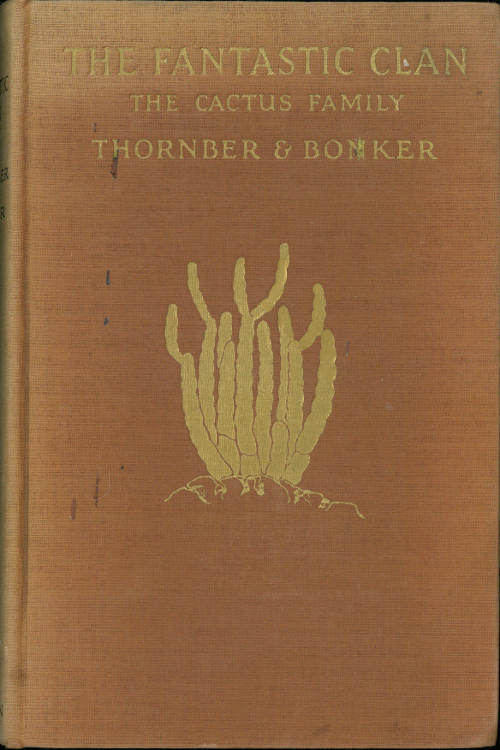 The Fantastic Clan: The Cactus Family
by J. J. Thornber
The Fantastic Clan: The Cactus Family
by J. J. Thornber