
The Past Condition of Organic Nature / Lecture II. (of VI.), "Lectures to Working Men", at the Museum of Practical Geology, 1863, on Darwin's Work: "Origin of Species"
Explore more books like this:
About This Book
The lecture first summarizes contemporary views of organic nature, showing that animal and plant diversity can be reduced to a few structural types and ultimately to cellular organization, and that organic matter cycles with the inorganic world; it then turns to the earth's past, treating the geological record as sedimentary mud and strata produced by rivers and seas. It explains how particle sorting during deposition creates a relative chronology, why the fossil record is necessarily incomplete, and how careful interpretation of strata and fossils provides evidence for historical changes in life and supports evolutionary explanation.
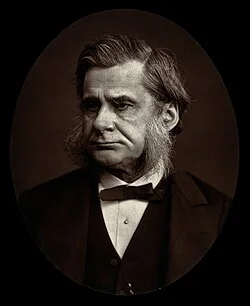
About the Author
More Books by This Author
6 picks
 A Critical Examination of the Position of Mr. Darwin's Work, "On the Origin of Species," in Relation to the Complete Theory of the Causes of the Phenomena of Organic Nature / Lecture VI. (of VI.), "Lectures to Working Men", at the Museum of Practical Geology, 1863, on Darwin's Work: "Origin of Species"
by Thomas Henry Huxley
A Critical Examination of the Position of Mr. Darwin's Work, "On the Origin of Species," in Relation to the Complete Theory of the Causes of the Phenomena of Organic Nature / Lecture VI. (of VI.), "Lectures to Working Men", at the Museum of Practical Geology, 1863, on Darwin's Work: "Origin of Species"
by Thomas Henry Huxley
 American Addresses, with a Lecture on the Study of Biology
by Thomas Henry Huxley
American Addresses, with a Lecture on the Study of Biology
by Thomas Henry Huxley
 Aphorisms and Reflections from the works of T. H. Huxley
by Thomas Henry Huxley
Aphorisms and Reflections from the works of T. H. Huxley
by Thomas Henry Huxley
 Autobiography and Selected Essays
by Thomas Henry Huxley
Autobiography and Selected Essays
by Thomas Henry Huxley
 Collected Essays, Volume V / Science and Christian Tradition: Essays
by Thomas Henry Huxley
Collected Essays, Volume V / Science and Christian Tradition: Essays
by Thomas Henry Huxley
 Coral and Coral Reefs
by Thomas Henry Huxley
Coral and Coral Reefs
by Thomas Henry Huxley
You May Also Like
6 picks
 Comments on the Taxonomic Status of Apodemus peninsulae, with Description of a New Subspecies from North China
by J. Knox Jones
Comments on the Taxonomic Status of Apodemus peninsulae, with Description of a New Subspecies from North China
by J. Knox Jones
 Life and Letters of Charles Darwin — Volume 2
by Charles Darwin
Life and Letters of Charles Darwin — Volume 2
by Charles Darwin
 Methods of Destroying Rats
by David E. Lantz
Methods of Destroying Rats
by David E. Lantz
 A Short History of the Book of Common Prayer
by William Reed Huntington
A Short History of the Book of Common Prayer
by William Reed Huntington
 Gipsy Life / Being an account of our Gipsies and their children, with suggestions for their improvement
by George Smith
Gipsy Life / Being an account of our Gipsies and their children, with suggestions for their improvement
by George Smith
 Reminiscences of Peace and War
by Sara Agnes Rice Pryor
Reminiscences of Peace and War
by Sara Agnes Rice Pryor