
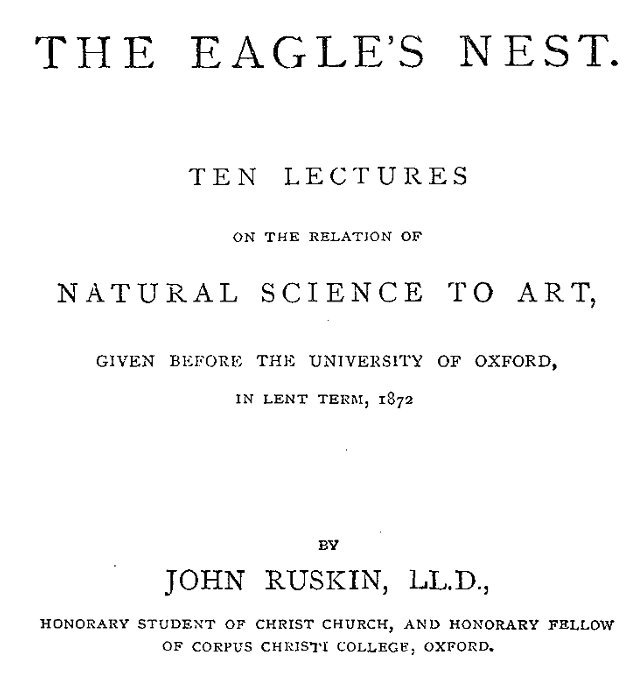
The Eagle's Nest / Ten Lectures on the Relation of Natural Science to Art, Given Before the University of Oxford, in Lent Term, 1872
Explore more books like this:
About This Book
A series of lectures that argues for a disciplined relationship between natural science and artistic practice, defining distinct roles for scientific knowledge, practical making, and imaginative thought while warning that excessive anatomical focus can damage artistic feeling. The author considers the virtues needed in art, analyzes how light and forms both inorganic and organic affect design, and prescribes elementary exercises for physiologic and historic drawing. Mixing philosophical reflection with concrete guidance, the lectures stress careful observation, moral judgment, and simplicity as foundations for truthful and beautiful representation.
About the Author
More Books by This Author
6 picks
 "Præterita": souvenirs de jeunesse
by John Ruskin
"Præterita": souvenirs de jeunesse
by John Ruskin
 A Joy For Ever (and Its Price in the Market)
by John Ruskin
A Joy For Ever (and Its Price in the Market)
by John Ruskin
 Aratra Pentelici, Seven Lectures on the Elements of Sculpture / Given before the University of Oxford in Michaelmas Term, 1870
by John Ruskin
Aratra Pentelici, Seven Lectures on the Elements of Sculpture / Given before the University of Oxford in Michaelmas Term, 1870
by John Ruskin
 Ariadne Florentina: Six Lectures on Wood and Metal Engraving
by John Ruskin
Ariadne Florentina: Six Lectures on Wood and Metal Engraving
by John Ruskin
 Fors Clavigera (Volume 6 of 8) /
by John Ruskin
Fors Clavigera (Volume 6 of 8) /
by John Ruskin
 Giotto and his works in Padua / An Explanatory Notice of the Series of Woodcuts Executed for the Arundel Society After the Frescoes in the Arena Chapel
by John Ruskin
Giotto and his works in Padua / An Explanatory Notice of the Series of Woodcuts Executed for the Arundel Society After the Frescoes in the Arena Chapel
by John Ruskin
You May Also Like
6 picks
 The Life and Public Service of General Zachary Taylor: An Address
by Abraham Lincoln
The Life and Public Service of General Zachary Taylor: An Address
by Abraham Lincoln
 Petroleum
by Albert Lidgett
Petroleum
by Albert Lidgett
 A Traveller in Little Things
by W. H. Hudson
A Traveller in Little Things
by W. H. Hudson
 What to Do? Thoughts Evoked by the Census of Moscow
by graf Leo Tolstoy
What to Do? Thoughts Evoked by the Census of Moscow
by graf Leo Tolstoy
 That Gospel Sermon on the Blessed Hope
by Dwight Lyman Moody
That Gospel Sermon on the Blessed Hope
by Dwight Lyman Moody
 Omphalos: An Attempt to Untie the Geological Knot
by Philip Henry Gosse
Omphalos: An Attempt to Untie the Geological Knot
by Philip Henry Gosse