
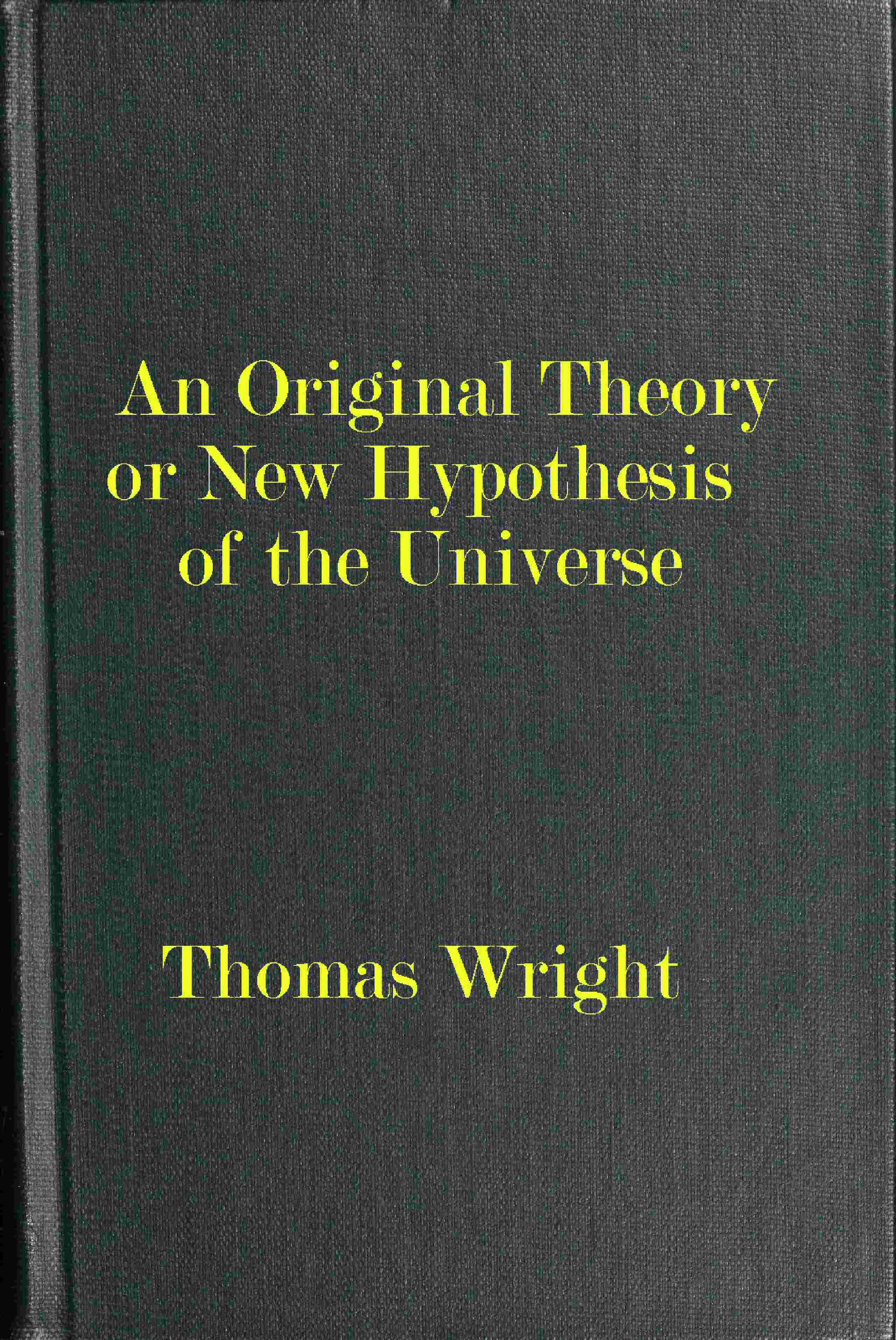
About This Book
Presented as nine letters, the work develops a mathematical hypothesis that interprets the Milky Way as a flattened, system-like arrangement of stars and extends that model to the sizes, motions, and distances of planets, stars, and nebulae. It assesses observational evidence and degrees of probability, offers estimates of cosmic scale, and argues that many faint nebulae are remote, galaxy-like systems. Throughout, the author connects these cosmological ideas to questions of order, final causes, and the theological and moral implications of a vast hierarchical universe.
About the Author

More Books by This Author
4 picks
 A History of Caricature and Grotesque in Literature and Art
by Thomas Wright
A History of Caricature and Grotesque in Literature and Art
by Thomas Wright
 A History of Domestic Manners and Sentiments in England During the Middle Ages
by Thomas Wright
A History of Domestic Manners and Sentiments in England During the Middle Ages
by Thomas Wright
 The Life of Sir Richard Burton
by Thomas Wright
The Life of Sir Richard Burton
by Thomas Wright
 The Ruins of the Roman City of Uriconium, at Wroxeter, near Shrewsbury
by Thomas Wright
The Ruins of the Roman City of Uriconium, at Wroxeter, near Shrewsbury
by Thomas Wright
You May Also Like
6 picks
 The Intellectual Life
by Philip Gilbert Hamerton
The Intellectual Life
by Philip Gilbert Hamerton
 Il libro delle figurazioni ideali
by Gian Pietro Lucini
Il libro delle figurazioni ideali
by Gian Pietro Lucini
 The mutual influence of Christianity and the Stoic school
by James Henry Bryant
The mutual influence of Christianity and the Stoic school
by James Henry Bryant
 The Church, the Schools and Evolution
by J. E. Conant
The Church, the Schools and Evolution
by J. E. Conant
 The Enchiridion
by Epictetus
The Enchiridion
by Epictetus
 Träume eines Geistersehers, erläutert durch Träume der Metaphysik
by Immanuel Kant
Träume eines Geistersehers, erläutert durch Träume der Metaphysik
by Immanuel Kant