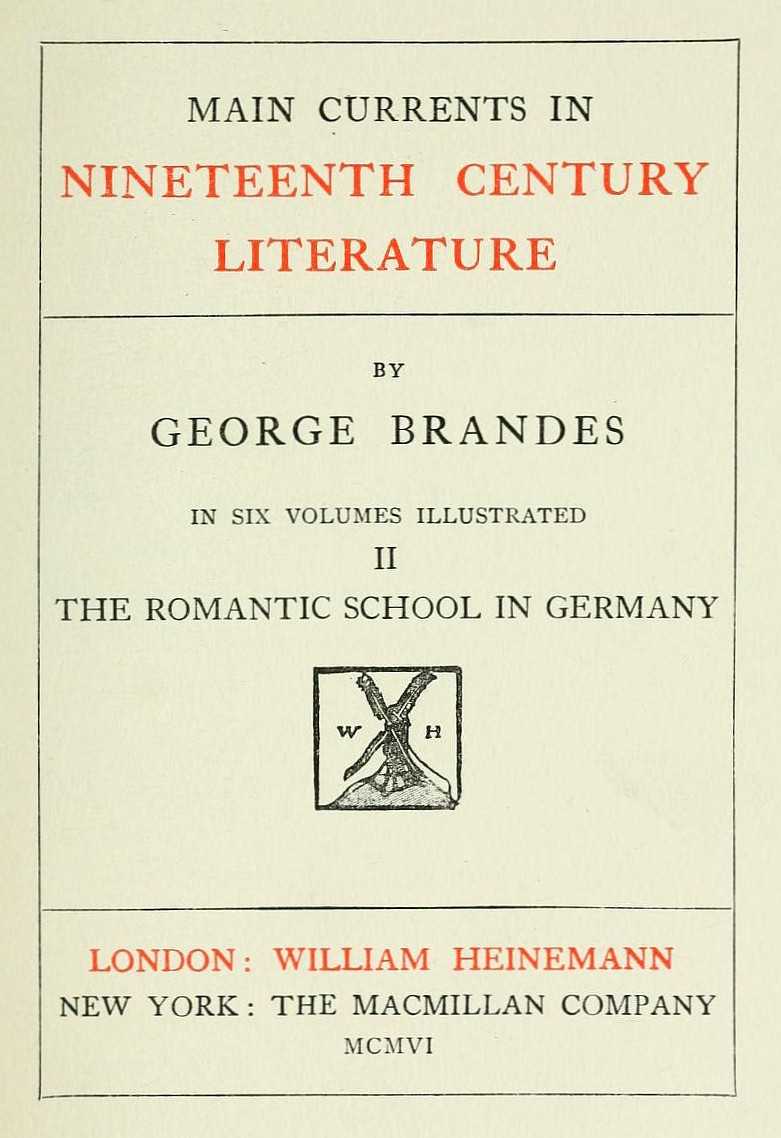
Main Currents in Nineteenth Century Literature - 2. The Romantic School in Germany
Explore more books like this:
About This Book
The volume surveys the German Romantic movement, tracing its origins and charting major figures and groups while interpreting their aesthetics and social aims. Brandes profiles pioneers and poets, critics and novelists, and examines recurring motifs such as longing and the blue-flower symbol, mysticism, idealized nature, artistic duplication, and the Romantic view of music and drama. He investigates tensions between form and life, critiques of contemporary society, experiments in genre, controversies over works like Lucinde, and the movement's political and social engagements, linking psychological tendencies to broader cultural reception and the shift from earlier classicist models.
About the Author
More Books by This Author
6 picks
 Anatole France
by Georg Brandes
Anatole France
by Georg Brandes
 Eminent Authors of the Nineteenth Century: Literary Portraits
by Georg Brandes
Eminent Authors of the Nineteenth Century: Literary Portraits
by Georg Brandes
 Friedrich Nietzsche
by Georg Brandes
Friedrich Nietzsche
by Georg Brandes
 Main Currents in Nineteenth Century Literature - 1. The Emigrant Literature
by Georg Brandes
Main Currents in Nineteenth Century Literature - 1. The Emigrant Literature
by Georg Brandes
 Main Currents in Nineteenth Century Literature - 3. The Reaction in France
by Georg Brandes
Main Currents in Nineteenth Century Literature - 3. The Reaction in France
by Georg Brandes
 Main Currents in Nineteenth Century Literature - 4. Naturalism in England
by Georg Brandes
Main Currents in Nineteenth Century Literature - 4. Naturalism in England
by Georg Brandes
You May Also Like
6 picks