
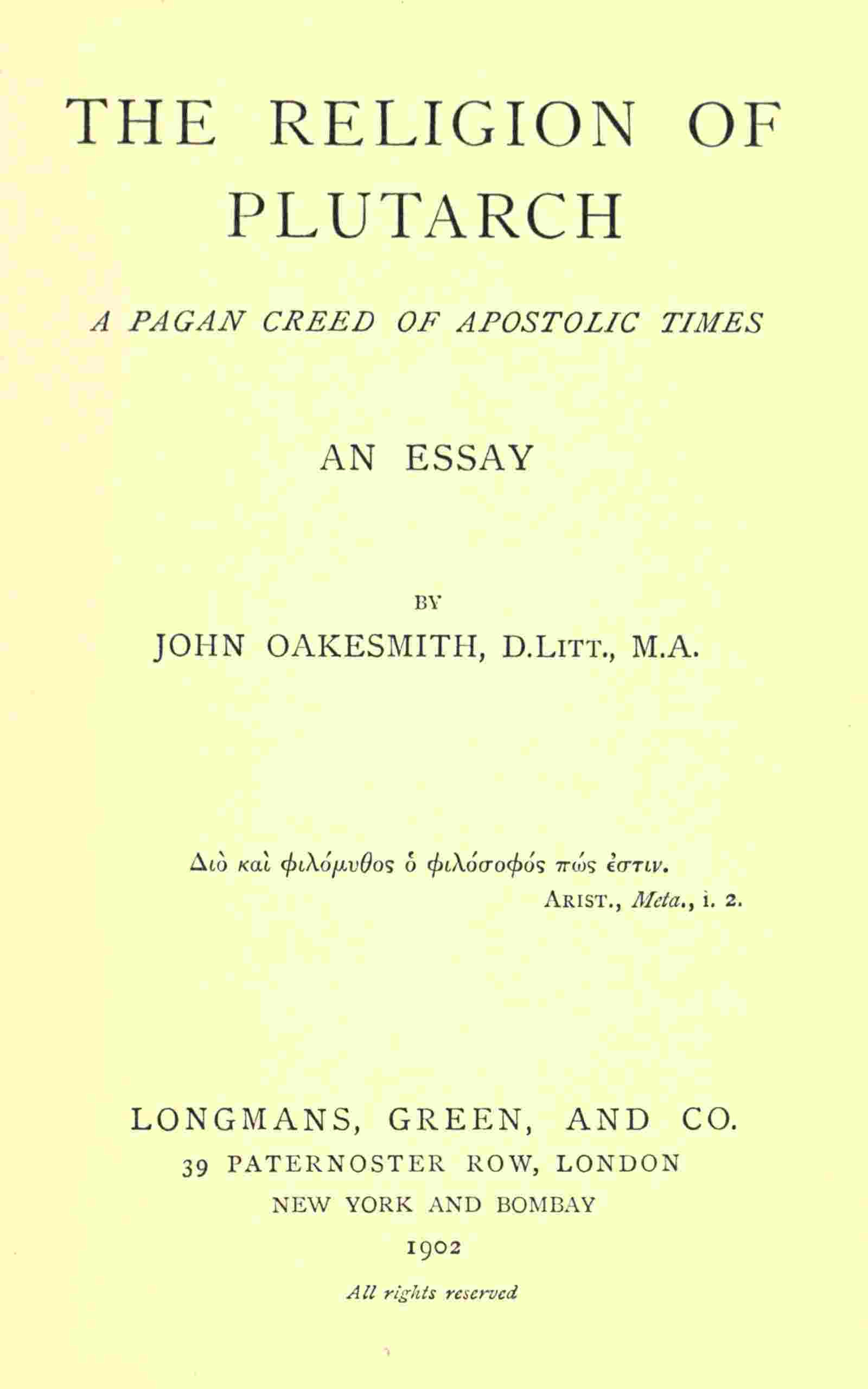
About This Book
The essay examines Plutarch’s religious thought as presented in his ethical writings, tracing how he reconciles traditional Greco-Roman cult, myth, and ritual with philosophical theology. It surveys passages from the Moralia to show Plutarch’s use of allegory, moralizing interpretation, and syncretic engagement with Platonic and other schools, and discusses his methods for making ancient beliefs a source of ethical guidance. The author evaluates textual evidence, editorial choices, and historical context, highlights recurring themes such as providence, immortality, and the moral purpose of rites, and considers how these convictions shaped Plutarch’s wider moral and social reflections.
About the Author

You May Also Like
6 picks
 The Pocket Lavater; or, The Science of Physiognomy / To which is added an inquiry into the analogy existing between brute and human physiognomy
by Johann Caspar Lavater
The Pocket Lavater; or, The Science of Physiognomy / To which is added an inquiry into the analogy existing between brute and human physiognomy
by Johann Caspar Lavater
 Arabian Wisdom: Selections and Translations from the Arabic
by John Wortabet
Arabian Wisdom: Selections and Translations from the Arabic
by John Wortabet
 Scarabs / The History, Manufacture and Symbolism of the Scarabæus in Ancient Egypt, Phoenicia, Sardinia, Etruria, etc.
by Isaac Myer
Scarabs / The History, Manufacture and Symbolism of the Scarabæus in Ancient Egypt, Phoenicia, Sardinia, Etruria, etc.
by Isaac Myer
 Merenvirta: Lasten Punainen Huvitus II
by Gotthilf Heinrich von Schubert
Merenvirta: Lasten Punainen Huvitus II
by Gotthilf Heinrich von Schubert
 The Toilers of the Field
by Richard Jefferies
The Toilers of the Field
by Richard Jefferies
 As We Go
by Charles Dudley Warner
As We Go
by Charles Dudley Warner