
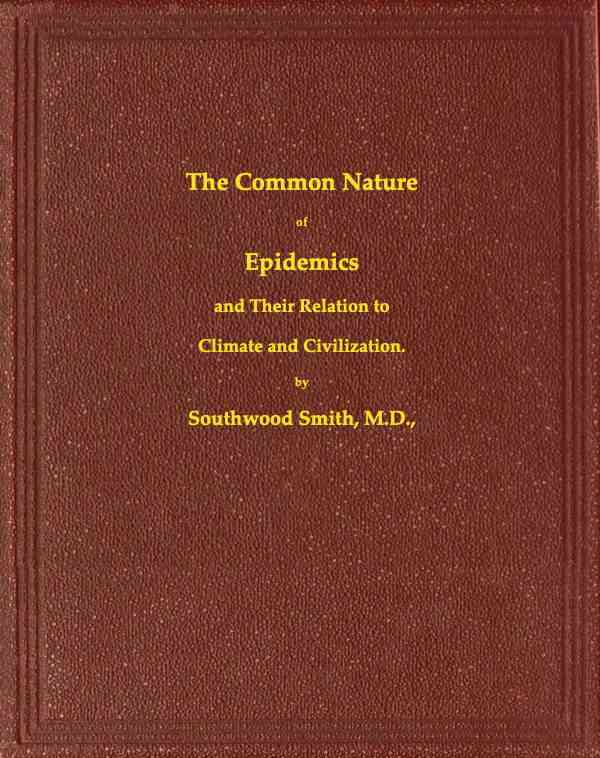
The Common Nature of Epidemics, and their relation to climate and civilization
Explore more books like this:
About This Book
The text analyzes epidemics as a class of fevers linked to environmental and social conditions rather than exclusively to contagion, arguing that factors such as foul air, overcrowding, climate, and animal murrains contribute to their onset, periodicity, and meteorological associations. It reviews historical patterns, critiques quarantine and contagion theories with case examinations, and advocates sanitary measures, public-health legislation, and ship regulation as primary protections. The work combines clinical observation, official reports, and lectures to recommend practical reforms and documents sanitary projects and experience to show how epidemic risk can be mitigated through improved hygiene, housing, and urban sanitation.
About the Author

More Books by This Author


You May Also Like
 Rural Hygiene
by Henry N. Ogden
Rural Hygiene
by Henry N. Ogden
 Transmission; or, Variation of Character Through the Mother
by Georgiana Bruce Kirby
Transmission; or, Variation of Character Through the Mother
by Georgiana Bruce Kirby
 Lehrbuch der Toxikologie für Tierärzte
by Eugen Fröhner
Lehrbuch der Toxikologie für Tierärzte
by Eugen Fröhner
 The Theory of Environment / An Outline of the History of the Idea of Milieu, and Its Present Status, part 1
by Armin Hajman Koller
The Theory of Environment / An Outline of the History of the Idea of Milieu, and Its Present Status, part 1
by Armin Hajman Koller
 An essay on the government of children, under three general heads, viz. health, manners, and education
by James Nelson
An essay on the government of children, under three general heads, viz. health, manners, and education
by James Nelson
 Fasting Girls: Their Physiology and Pathology
by William A. Hammond
Fasting Girls: Their Physiology and Pathology
by William A. Hammond