
About This Book
The essay argues that modern science and cultivated art often serve to rationalize social inequalities by presenting selective facts and abstract theories as objective truths; intellectual fashions like Hegelianism or Malthusianism secured authority not because they were verifiable but because their deductions suited the interests of the idle and powerful. The author traces how purportedly neutral methods—induction, experiment, and critical analysis—depend on prior choices about which facts to study, and warns that aesthetic and scientific claims devoid of moral purpose fail to guide human life. He urges a reorientation toward principles that connect thought and feeling with ethical responsibility rather than social justification.
About the Author

More Books by This Author
6 picks
 "Bethink Yourselves!"
by graf Leo Tolstoy
"Bethink Yourselves!"
by graf Leo Tolstoy
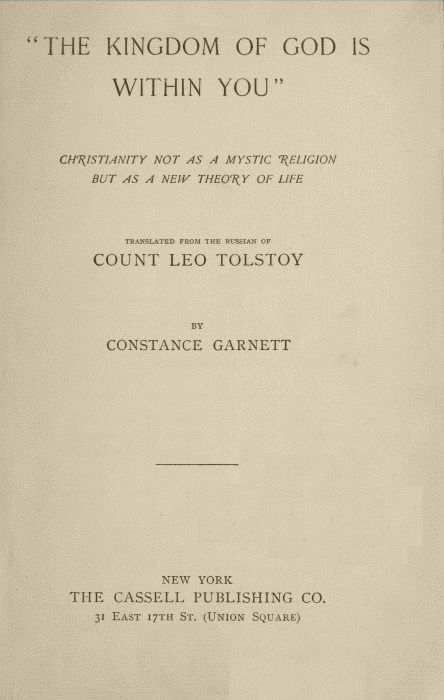 "The Kingdom of God Is Within You" / Christianity Not as a Mystic Religion but as a New Theory of Life
by graf Leo Tolstoy
"The Kingdom of God Is Within You" / Christianity Not as a Mystic Religion but as a New Theory of Life
by graf Leo Tolstoy
 A Letter to a Hindu
by graf Leo Tolstoy
A Letter to a Hindu
by graf Leo Tolstoy
 A Russian Proprietor, and Other Stories
by graf Leo Tolstoy
A Russian Proprietor, and Other Stories
by graf Leo Tolstoy
 Anna Karenina
by graf Leo Tolstoy
Anna Karenina
by graf Leo Tolstoy
 Anna Karénine, Tome I
by graf Leo Tolstoy
Anna Karénine, Tome I
by graf Leo Tolstoy
You May Also Like
6 picks
 Portugal perante a revolução de Hespanha / Considerações sobre o futuro da politica portugueza no ponto de vista da democracia iberica
by Antero de Quental
Portugal perante a revolução de Hespanha / Considerações sobre o futuro da politica portugueza no ponto de vista da democracia iberica
by Antero de Quental
 The Uncollected Writings of Thomas de Quincey—Vol. 1 / With a Preface and Annotations by James Hogg
by Thomas De Quincey
The Uncollected Writings of Thomas de Quincey—Vol. 1 / With a Preface and Annotations by James Hogg
by Thomas De Quincey
 The Book of Gud
by Milo Hastings
The Book of Gud
by Milo Hastings
 The Kabbalah: its doctrines, development, and literature
by Christian D. Ginsburg
The Kabbalah: its doctrines, development, and literature
by Christian D. Ginsburg
 Browning and His Century
by Helen A. Clarke
Browning and His Century
by Helen A. Clarke
 What is Property? An Inquiry into the Principle of Right and of Government
by P.-J. Proudhon
What is Property? An Inquiry into the Principle of Right and of Government
by P.-J. Proudhon