
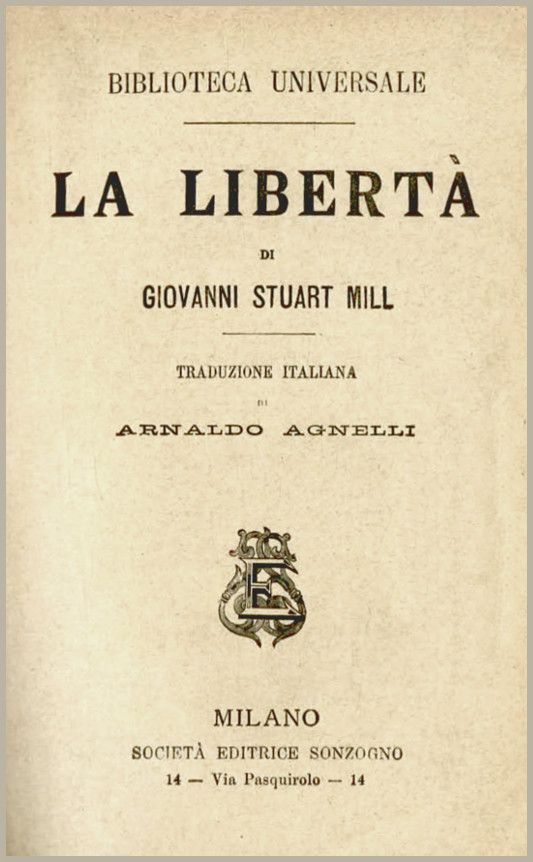
About This Book
The essay argues for the primacy of individual development and sets out a general rule limiting social and governmental interference: power over a person is justified only to prevent harm to others. It defends freedom of thought, discussion, and expression as essential to truth and personal growth, warns against the tyranny of prevailing opinion, and upholds liberty in tastes, pursuits, and associations so long as they do not harm others. It also champions individuality and experiments in living as engines of social progress and examines practical boundaries between collective authority and personal autonomy.
About the Author

More Books by This Author
6 picks
 A System of Logic, Ratiocinative and Inductive
by John Stuart Mill
A System of Logic, Ratiocinative and Inductive
by John Stuart Mill
 Auguste Comte and Positivism
by John Stuart Mill
Auguste Comte and Positivism
by John Stuart Mill
 Autobiography
by John Stuart Mill
Autobiography
by John Stuart Mill
 Considerations on Representative Government
by John Stuart Mill
Considerations on Representative Government
by John Stuart Mill
 Essays on some unsettled Questions of Political Economy
by John Stuart Mill
Essays on some unsettled Questions of Political Economy
by John Stuart Mill
 Index of the Project Gutenberg Works of John Stuart Mill
by John Stuart Mill
Index of the Project Gutenberg Works of John Stuart Mill
by John Stuart Mill
You May Also Like
6 picks
 Ιππίας, Μείζων και Ελάσσων
by Plato
Ιππίας, Μείζων και Ελάσσων
by Plato
 Spencer's Philosophy of Science / The Herbert Spencer Lecture Delivered at the Museum 7 November, 1913
by C. Lloyd Morgan
Spencer's Philosophy of Science / The Herbert Spencer Lecture Delivered at the Museum 7 November, 1913
by C. Lloyd Morgan
 Free and Impartial Thoughts, on the Sovereignty of God, The Doctrines of Election, Reprobation, and Original Sin: Humbly Addressed To all who Believe and Profess those Doctrines.
by Richard Finch
Free and Impartial Thoughts, on the Sovereignty of God, The Doctrines of Election, Reprobation, and Original Sin: Humbly Addressed To all who Believe and Profess those Doctrines.
by Richard Finch
 The Salvaging of Civilization
by H. G. Wells
The Salvaging of Civilization
by H. G. Wells
 Conception Control and Its Effects on the Individual and the Nation
by Florence Elizabeth Barrett
Conception Control and Its Effects on the Individual and the Nation
by Florence Elizabeth Barrett
 Religion & Sex: Studies in the Pathology of Religious Development
by Chapman Cohen
Religion & Sex: Studies in the Pathology of Religious Development
by Chapman Cohen