
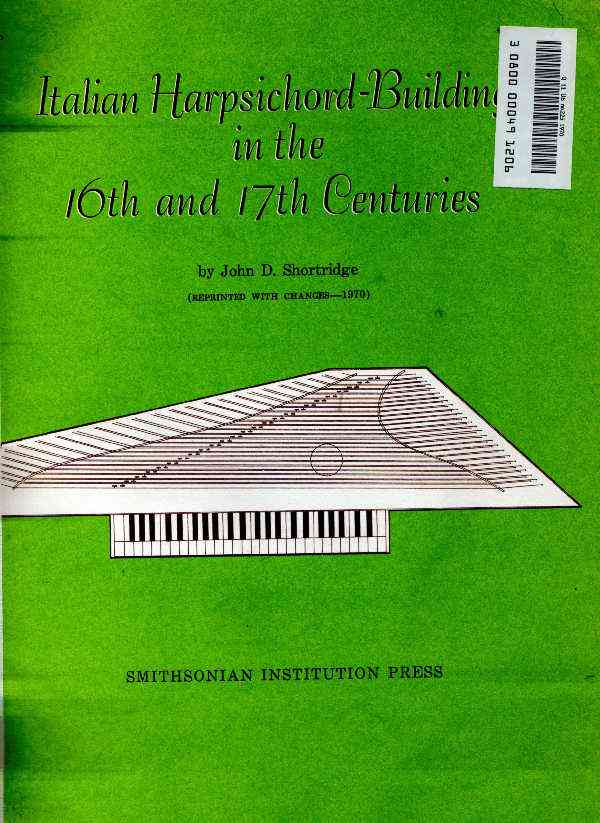
Italian Harpsichord-Building in the 16th and 17th Centuries
Explore more books like this:
About This Book
The study surveys Italian harpsichord and virginal construction in the 16th and 17th centuries, contrasting the simpler Italian models with northern European innovations such as second manuals and additional stops. It offers detailed descriptions and measurements of representative instruments, notably a polygonal virginal from the Hugo Worch collection, outlining outer case, soundboard, lining, ribs, bridges, jacks, and keyboard mechanics. Terminology and form distinctions, including the use of polygonal versus rectangular virginals and the definition of spinets, are clarified. Measurement-based analysis of 33 museum instruments addresses stringing, tuning, short-octave compass, and variations in vibrating string lengths, and the paper notes the enduring tonal character of Italian instruments.
About the Author

You May Also Like
 Bonaparte in Egypt and the Egyptians of To-day
by Abdullah Browne
Bonaparte in Egypt and the Egyptians of To-day
by Abdullah Browne
 Letters written in France, to a friend in London, between the month of November 1794, and the month of May 1795
by Watkin Tench
Letters written in France, to a friend in London, between the month of November 1794, and the month of May 1795
by Watkin Tench
 O Padroado Portuguez na China
by Alberto Feliciano Marques Pereira
O Padroado Portuguez na China
by Alberto Feliciano Marques Pereira
 Crónica de la conquista de Granada (1 de 2)
by Washington Irving
Crónica de la conquista de Granada (1 de 2)
by Washington Irving
 Style in Singing
by W. E. Haslam
Style in Singing
by W. E. Haslam
 Paris: A Sketch Book
by Eugène Béjot
Paris: A Sketch Book
by Eugène Béjot