
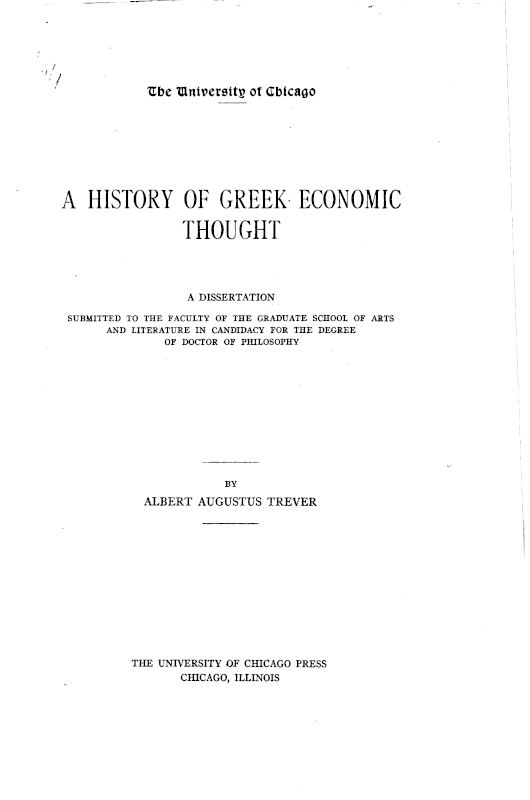
About This Book
This study reevaluates Greek economic theory by situating thinkers within their economic environment and comparing their humanitarian perspectives with modern concerns. Organized chronologically, it surveys pre-Platonic ideas and detailed treatments of Plato, Xenophon, the orators, Aristotle, and later schools, analyzing their views on value, wealth, production, money, exchange, population, and distribution. Special attention is paid to agriculture, capital, labor including division of labor and slavery, and to debates over interest, tariffs, and the moral limits of acquisition. It examines communistic and socialistic proposals alongside critics' reactions, and contrasts household-focused oikonomia with public economy. The conclusion assesses the scope and influence of Greek economic thought, arguing that ethical concerns often shaped economic prescriptions and that accurate interpretation requires understanding contemporary conditions.
About the Author

You May Also Like
 Our Benevolent Feudalism
by William J. Ghent
Our Benevolent Feudalism
by William J. Ghent
 Volcanoes: Past and Present
by Edward Hull
Volcanoes: Past and Present
by Edward Hull
 The Storehouses of the King; Or, the Pyramids of Egypt / What They Are and Who Built Them
by Jane van Gelder
The Storehouses of the King; Or, the Pyramids of Egypt / What They Are and Who Built Them
by Jane van Gelder
 The History of Rome (Volumes 1-5)
by Theodor Mommsen
The History of Rome (Volumes 1-5)
by Theodor Mommsen
 Ocean's Story; or, Triumphs of Thirty Centuries / Maritime Adventures, Achievements, Explorations, Discoveries and Inventions; and of the Rise and Progress of Ship-Building and Ocean Navigation, from the Ark to the Iron Steamships
by Frank B. Goodrich
Ocean's Story; or, Triumphs of Thirty Centuries / Maritime Adventures, Achievements, Explorations, Discoveries and Inventions; and of the Rise and Progress of Ship-Building and Ocean Navigation, from the Ark to the Iron Steamships
by Frank B. Goodrich
 The discovery and decipherment of the trilingual cuneiform inscriptions
by Arthur John Booth
The discovery and decipherment of the trilingual cuneiform inscriptions
by Arthur John Booth