
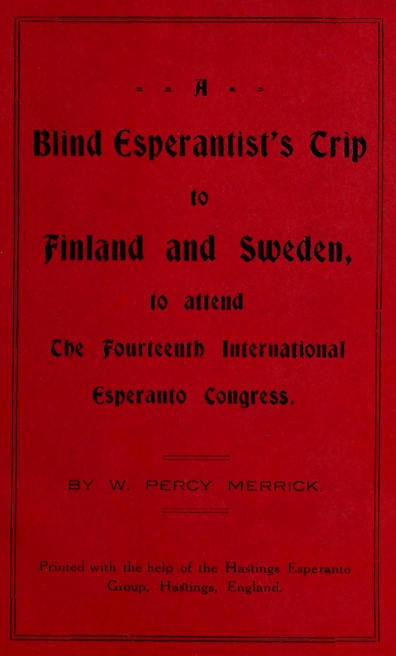
A Blind Esperantist's Trip to Finland and Sweden, to Attend the Fourteenth International Esperanto Congress
Explore more books like this:
About This Book
The narrator recounts travel to attend an international Esperanto congress in Finland and Sweden, describing the voyage by ship, life aboard, and reception on arrival; arrangements for blind delegates, social events, meetings, concerts, theatre, and national dances; observations of local customs, food, architecture, and musical traditions including performances of the Kalevala, choir singing, and a Finnish play in Esperanto; excursions to towns, visits to a blind school, and practical details about hotels, transport, and hospitality, interwoven with reflections on the congenial international fellowship among Esperantists.
About the Author

You May Also Like
6 picks
 Faery Lands of the South Seas
by James Norman Hall
Faery Lands of the South Seas
by James Norman Hall
 A Montessori Mother
by Dorothy Canfield Fisher
A Montessori Mother
by Dorothy Canfield Fisher
 The West Indies and the Spanish Main
by Anthony Trollope
The West Indies and the Spanish Main
by Anthony Trollope
 Le trésor des équivoques, antistrophes, ou contrepéteries
by Léon Dupré-Carra
Le trésor des équivoques, antistrophes, ou contrepéteries
by Léon Dupré-Carra
 The exploration of Tibesti, Erdi, Borkou, and Ennedi in 1912-1917
by Jean Tilho
The exploration of Tibesti, Erdi, Borkou, and Ennedi in 1912-1917
by Jean Tilho
 Famous Persons and Places
by Nathaniel Parker Willis
Famous Persons and Places
by Nathaniel Parker Willis