
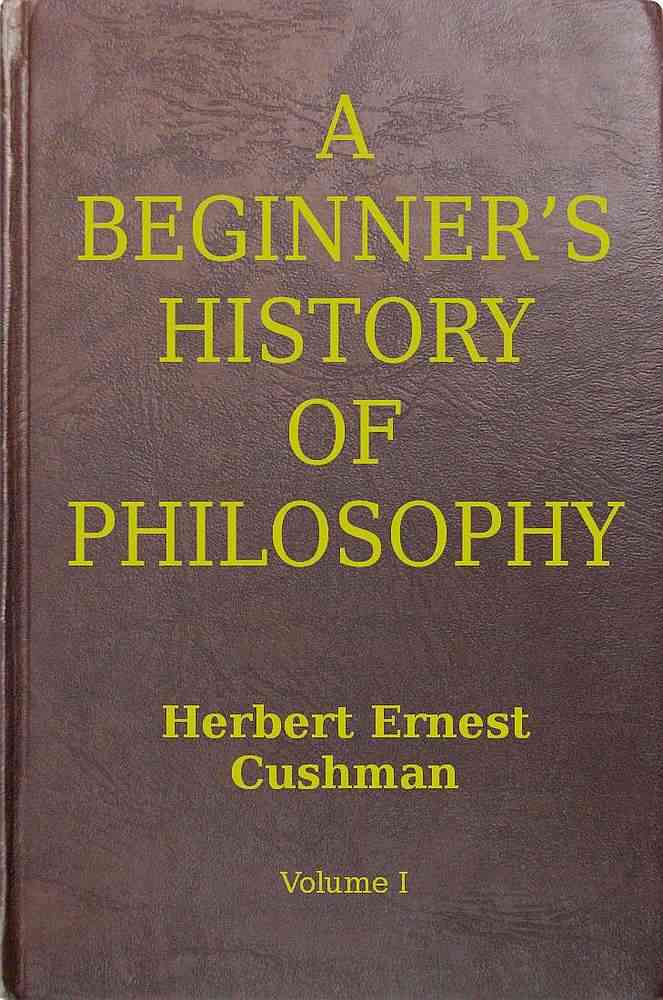
A Beginner's History of Philosophy, Vol. 1: Ancient and Mediæval Philosophy
A concise textbook traces the development of Western philosophical ideas from early Greek inquiries into nature through the plurality and anthropological turns and into medieval thought. It surveys cosmologists, reconciliatory pluralists, the rise of ethical and anthropological reflection, and the later synthesis of ancient and medieval doctrines, emphasizing intellectual context—geography, politics, and literature—and pedagogical tools such as summaries, tables, maps, and selected passages. Technical arguments are simplified to highlight leading doctrines and historical connections, making the material accessible for beginning students while leaving room for classroom interpretation.
About This Book
A concise textbook traces the development of Western philosophical ideas from early Greek inquiries into nature through the plurality and anthropological turns and into medieval thought. It surveys cosmologists, reconciliatory pluralists, the rise of ethical and anthropological reflection, and the later synthesis of ancient and medieval doctrines, emphasizing intellectual context—geography, politics, and literature—and pedagogical tools such as summaries, tables, maps, and selected passages. Technical arguments are simplified to highlight leading doctrines and historical connections, making the material accessible for beginning students while leaving room for classroom interpretation.
About the Author

More Books by This Author
You May Also Like
 "De Bello Gallico" and Other Commentaries
by Julius Caesar
"De Bello Gallico" and Other Commentaries
by Julius Caesar
 A Brief History of Element Discovery, Synthesis, and Analysis
by Glen W. Watson
A Brief History of Element Discovery, Synthesis, and Analysis
by Glen W. Watson
 A Burial Cave in Baja California / The Palmer Collection, 1887
by William C. Massey
A Burial Cave in Baja California / The Palmer Collection, 1887
by William C. Massey
 A century of excavation in the land of the Pharaohs
by James Baikie
A century of excavation in the land of the Pharaohs
by James Baikie
 A classical dictionary / containing a copious account of all the proper names mentioned in ancient authors with tables of coins, weights, and measures used among the Greeks and Romans and a chronological table
by John Lemprière
A classical dictionary / containing a copious account of all the proper names mentioned in ancient authors with tables of coins, weights, and measures used among the Greeks and Romans and a chronological table
by John Lemprière
 A Commentary on Herodotus
by W. W. How
A Commentary on Herodotus
by W. W. How